Careers

Support

Contact

Run and Sprint

From walking to running: safe progression

REHAB

Introduction

The return to running is one of the most critical phases of the rehabilitative pathway: it is not enough to start running again, it is fundamental to do so with a correct motor pattern, reducing the risk of overload and relapse.

Parameters such as step frequency and length, contact times, symmetry and posture describe running quality and its evolution over time. Alterations in these parameters, often present before the onset of pain, are early signs of incomplete recovery. Objectively monitoring them allows guiding progression safely, from controlled walking to running, sprinting and reaching competition speeds.

Optogait analyses the running pattern on a treadmill or on the ground; integrated with GykoPro, it adds information on accelerations and postural control. Witty Timing allows validating progression towards performance through measurement of sprints and intermediate times.

01
Analisi del Pattern di Corsa
Rilevamento di asimmetrie, variabilità e compensi come segnali di recupero incompleto
progressione
02
Biofeedback & Correzione
Feedback in tempo reale su simmetria, cadenza e controllo posturale
validazione
03
Progressione verso lo Sprint
Misurazione di accelerazioni e tempi a intensità crescente
output
Rientro alla Performance
CamminataCorsaSprint
01
Running Pattern Analysis
Detection of asymmetries, variability and compensations as signs of incomplete recovery
progression
02
Biofeedback & Correction
Real-time feedback on symmetry, cadence and postural control
validation
03
Progression to Sprint
Measurement of accelerations and times at increasing intensity
output
Return to Performance
WalkRunSprint
01
Analyse des Laufmusters
Erkennung von Asymmetrien, Variabilität und Kompensationen als Zeichen unvollständiger Erholung
Progression
02
Biofeedback & Korrektur
Echtzeit-Feedback zu Symmetrie, Kadenz und Haltungskontrolle
Validierung
03
Progression zum Sprint
Messung von Beschleunigungen und Zeiten bei zunehmender Intensität
Output
Rückkehr zur Leistung
GehenLaufenSprint

[1] Florkiewicz, E.M., et al. "The effects of telehealth running gait retraining on biomechanics, pain, and function in patients with lower extremity injuries: a randomized clinical trial." Physical Therapy in Sport (2024). doi: 10.1016/j.ptsp.2024.

[2] Vincent, H.K., et al. "Reference biomechanical parameters and natural asymmetry among runners across the age spectrum without a history of running-related injuries." Front. Sports Act. Living 7 (2025): 1560756.

[3] Wayner, R.A., Robinson, R., Simon, J.E. "Gait asymmetry and running-related injury in female collegiate cross-country runners." Phys. Ther. Sport 59 (2023): 1–6.

Examples of configurations:
flexible and customizable

The resumption of running requires objective monitoring of symmetry, step quality and postural control to reduce relapse risk. It is important to analyse the running pattern, then progressively introduce sprinting and validate the return to full performance with measurable criteria.

Contact Us
Configuration 1

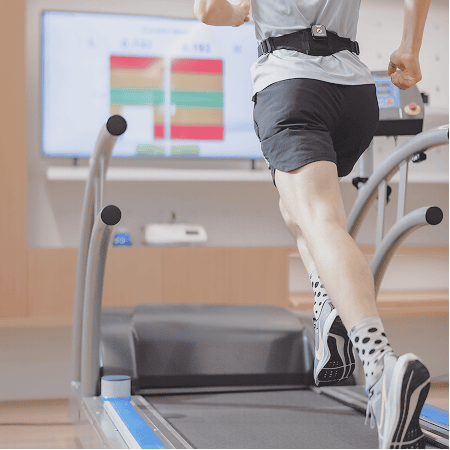
Analysing running and identifying asymmetries

Optogait measures cadence, stride length, contact and flight times for each limb, identifying asymmetries and
variability indicative of incomplete recovery. GykoPro integrates the analysis with data on vertical accelerations and postural control. Time-based monitoring allows guiding the resumption of running progressively and safely.
Configuration 2

Progressing towards sprinting

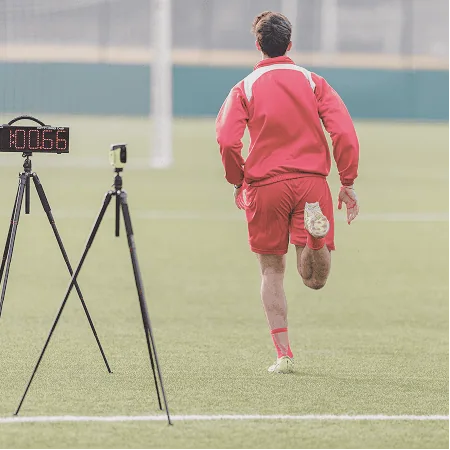
Once running quality is re-established, Witty Timing introduces measurement of sprints and accelerations at increasing intensity. Time and speed data allow comparing performance with pre-injury values or the contralateral limb, providing objective criteria for return to competition speeds.
Configuration 3

Optimising the pattern with biofeedback

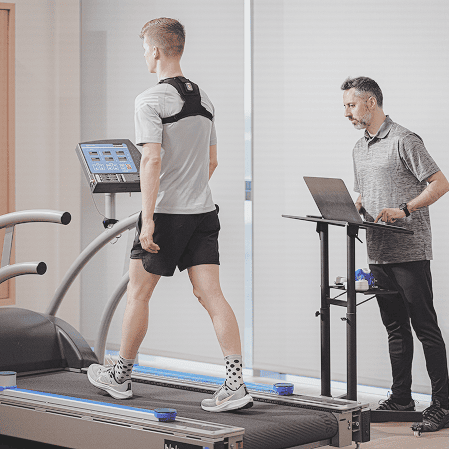
During treadmill running, Optogait provides real-time feedback on symmetry and cadence, guiding the patient towards the optimal pattern. GykoPro adds information on trunk compensations and postural alignment, as well
as accelerations during the ground contact phase, allowing simultaneous work on mechanical efficiency and movement control.

Products suited for this field of application

Optogait analyses the running pattern through spatiotemporal parameters, detecting asymmetries and variability. GykoPro integrates the analysis with data on accelerations and trunk control. Witty Timing measures sprints and accelerations, providing objective criteria to validate the return to full performance.
Photocell for equestrian sports

Photocells

Timing product configuration

Software Applications

Athlete Identification

Identification Systems

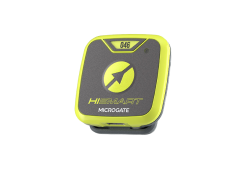
Starting gate

Starting Systems

Timing management

Software Applications

Three-sided lap counter

Scoreboards

Scoreboard

Scoreboards

Scoreboard

Scoreboards

Scoreboard

Scoreboards

Competition management software

Software Applications

OUR COMPOSITE SYSTEMS

Rehab Lab

The Microgate portable laboratory offers a comprehensive solution to evaluate and support rehabilitation pathways and adapted motor activity. It integrates GYKO Pro for strength, balance and mobility, Optogait for the analysis of walking, running and functional movements, and WITTy SEM for agility exercises and cognitive stimuli. It enables real-time monitoring and immediate feedback, helping physical therapists and providers identify compensations, asymmetries, and weaknesses, guiding movement reprogramming and planning personalized and safe training programs.

Download PDF

Timing on the move

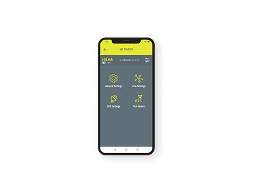
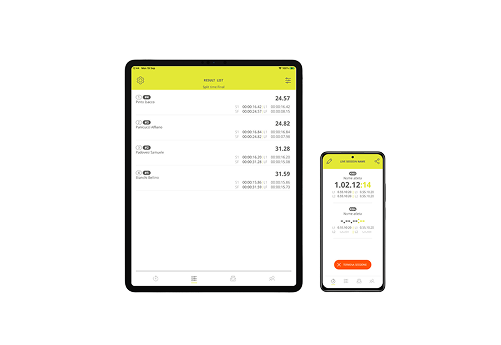
Manage workouts, settings, and results directly from your smartphone or tablet.

Manage training sessions, device settings, and results directly from your smartphone or tablet.
The HiTiming, HiChrono, and HiSettings apps make timing simpler, faster, and more intuitive: from device configuration to real-time results visualization, data analysis, and sharing. A connected ecosystem designed to work anywhere, even directly on the slope.

OTHER AREAS OF APPLICATION FOR REHAB