Careers

Support

Contact

Gait analysis

Measuring gait to guide rehabilitation

Rehabilitation

Introduction

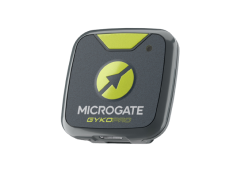
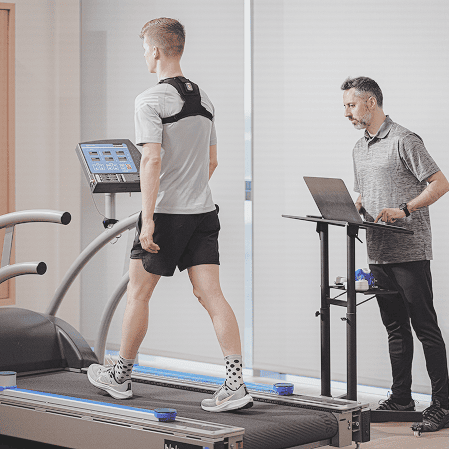
Walking is the basis of autonomy and locomotion. Analysing it objectively is fundamental to understanding the impact of a pathology, guiding the rehabilitative pathway and monitoring progress over time. Movement disorders, injuries, neurological pathologies and ageing generate asymmetries, variability and compensations that increase fall risk and reduce movement efficiency. Parameters such as cadence, step length, contact times and gait variability precisely describe walking quality and its evolution during treatment. Optogait assesses walking under natural conditions or on a treadmill without requiring complex laboratories or multiple professionals, providing reliable data on instability, asymmetries and compensations. Integrated with GykoPro, it also allows monitoring trunk compensations, optimising postural alignment and stability during the entire recovery pathway. Integrated with GykoPro, it also allows monitoring trunk compensations, optimising postural alignment and stability during the entire recovery pathway.

01
Baseline Assessment
Spatiotemporal gait analysis under natural conditions or on a treadmill
detects
02
Asymmetries & Compensations
Side-to-side imbalances, stride variability and trunk compensations
guides
03
Targeted Intervention
Personalised rehabilitation protocol addressing the root cause of the deficit
monitoring
04
Documented Progression
Session-by-session comparison to evaluate treatment effectiveness
output
Autonomy & Gait Quality
Reduced fall risk and recovery of functional locomotion

[1] Rozanski G, Delgado A, Putrino D. Spatiotemporal parameters from remote smartphone-based gait analysis are associated with lower extremity functional scale categories. Front Rehabil Sci. 2023;4:1189376. doi: 10.3389/fresc.2023.1189376.

[2] Lindemann U. Spatiotemporal gait analysis of older persons in clinical practice and research: which parameters are relevant? Z Gerontol Geriatr. 2020;53(2):171-178. doi: 10.1007/s00391-019-01520-8.

[3] Kokkotis C, Moustakidis S, Papageorgiou E, Giakas G, Tsaopoulos D. Present and future of gait assessment in clinical practice: towards the application of novel trends and technologies. Front Med Technol. 2022;4:901331. doi: 10.3389/fmedt.2022.901331.

Examples of configurations:
flexible and customizable

Objectively assessing gait is the starting point for guiding rehabilitation and monitoring progress. It is valuable to analyse spatiotemporal parameters, asymmetries and trunk compensations both under natural conditions and on a
treadmill, from baseline to fall prevention assessment.
Contact Us

Configuration 1

Defining the baseline

Spatiotemporal analysis of gait at spontaneous speed to establish an initial reference. OptoGait measures cadence, step length, contact times and symmetry, providing objective, repeatable and temporally comparable data. This represents the starting point for monitoring recovery evolution and guiding clinical decisions.
Configuration 2

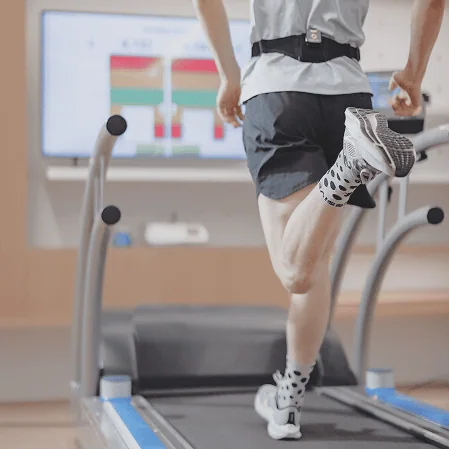
Assessing gait at different speeds

Gait analysis at controlled speeds (slow, spontaneous, fast) to observe how spatiotemporal parameters vary as demands increase. Variations in symmetry, stability and contact times allow identifying deficits that emerge only at higher speeds, providing useful indications for load progression and return to dynamic activities.
Configuration 3

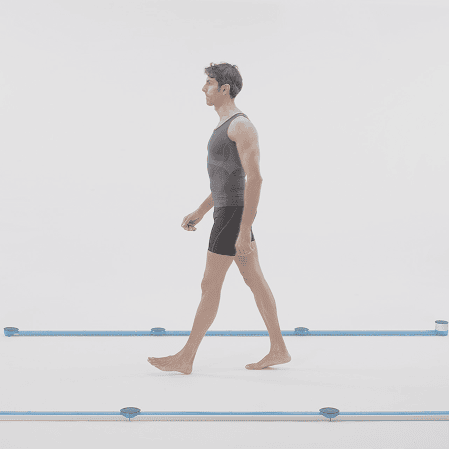
Comparing treadmill and overground walking

Gait assessment under different conditions to analyse adaptations and motor strategies.

The treadmill allows controlled and repeatable conditions, while overground walking introduces variability and more ecological demands. Comparing the two contexts highlights differences in coordination, stability and step management, improving the quality of functional assessment.

Products suited
for this field of application

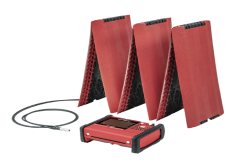
Optogait allows rapid and non-invasive gait analysis, on a treadmill or on the ground, without the need for complex laboratories. Integrated with GykoPro, it extends assessment to trunk compensations and postural alignment, offering a complete functional picture applicable in various clinical contexts.
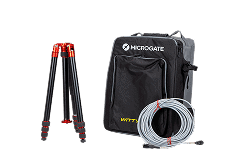
Cables, bags, tripods and more

Accessories

Training platform

Cognitive training

RFID chips and transponders

Identification Systems

Cameras and accessories

Photo Finish

Inertial system

Motor Evaluation

OUR COMPOSITE SYSTEMS

Rehab Lab

The Microgate portable laboratory offers a comprehensive solution for evaluating and supporting rehabilitation pathways and adapted physical activity. It integrates GykoPro for strength, balance, and mobility; OptoGait for gait, running, and functional movement analysis; and WittyPro SEM for agility exercises and cognitive stimuli. It enables real-time monitoring and immediate feedback, helping physiotherapists and specialists identify compensations, asymmetries, and weaknesses, while guiding movement reprogramming and the planning of personalized and safe training programs.

Download PDF

Real-time movement control

Turn every exercise into immediate and measurable feedback.

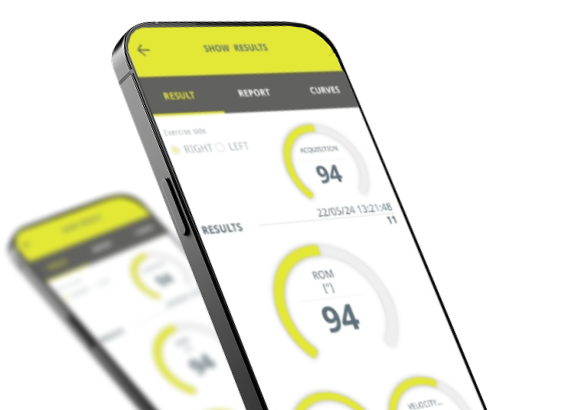
With ProMove and Microgate systems, you can monitor motor and biomechanical parameters in real time, analyzing data, asymmetries, and progress in a simple and intuitive way.
Configure personalized sessions for training, functional recovery, and neuromotor rehabilitation directly from your smartphone or tablet.

OTHER AREAS OF APPLICATION FOR REHAB