Careers

Support

Contact

Run and Sprint

Speed, control and efficiency at every step

Training

Introduction

Running and sprinting are fundamental movements in countless sports disciplines, where speed, acceleration and movement control determine performance. Analysing and training running does not mean only measuring the final time, but understanding how the athlete generates force, manages contact times, maintains symmetry and mechanical efficiency at different speeds. Parameters such as step frequency and length, contact and flight times, accelerations and posture directly influence speed, movement economy and overload risk. A modern approach
integrates assessment and training directly in the field, transforming every trial into an opportunity for motor learning. Through objective tools it is possible to monitor running quality under real conditions, guide technical adaptations and optimise performance in sprinting and the acceleration and deceleration phases typical of
modern sport.

01
Input
Forza applicata al suolo
applicazione
02
Modulazione
Parametri biomeccanici del passo
Tempo di contattoFrequenzaLunghezza passo
ottimizzazione
03
Trasferimento
Conversione della forza in movimento
PropulsioneRecupero elastico
output
Output
AccelerazioneVelocitàEconomia
01
Input
Force applied to the ground
application
02
Modulation
Biomechanical stride parameters
Contact TimeFrequencyStride Length
optimisation
03
Transfer
Conversion of force into movement
PropulsionElastic Recoil
output
Output
AccelerationVelocityEconomy
01
Input
Auf den Boden ausgeübte Kraft
Anwendung
02
Modulation
Biomechanische Schrittparameter
KontaktzeitFrequenzSchrittlänge
Optimierung
03
Transfer
Umwandlung von Kraft in Bewegung
PropulsionElastische Rückstellkraft
Output
Output
BeschleunigungGeschwindigkeitÖkonomie

[1] Lake, J., & Lauder, M. (2012). Measuring and Improving Running Symmetry in Elite Athletes. International Journal of Sports Physiology and Performance, 7(2), 125–132.

[2] Moura, T. B. M. A., Leme, J. C., Nakamura, F. Y., Cardoso, J. R., & Moura, F. A. (2024). Determinant biomechanical variables for each sprint phase performance in track and field: A systematic review. International Journal of Sports Science & Coaching, 19(1), 488-509.

[3] Hicks, D. S., Drummond, C., Williams, K. J., Pickering, C., & van den Tillaar, R. (2023). Individualization of training based on sprint force-velocity profiles: A conceptual framework for biomechanical and technical training recommendations. Strength & Conditioning Journal, 45(6), 711-725.

Examples of configurations:
flexible and customizable

Training and assessment of running and sprint through acceleration, maximum speed and pace change tests. Measuring times, step frequency and contact parameters allows improving efficiency, symmetry and control, reducing the risk of compensations and optimising field performance.

Contact Us
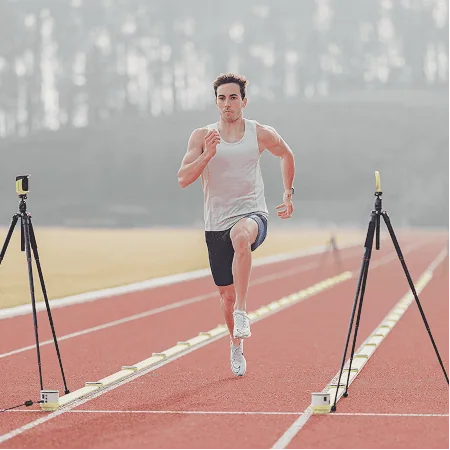
Configuration 1

Linear sprint and acceleration

For sprint performance, cadence and step length matter. Witty Timer precisely measures intermediate and final times and it is possible to connect the start impulse and display board, while Optojump allows detailed analysis of each individual foot contact (position, foot behaviour, acceleration, speed…) from the blocks exit to the flying phase. It can also be applied in team sports to channel and best structure acceleration and deceleration phases, key for injury prevention.
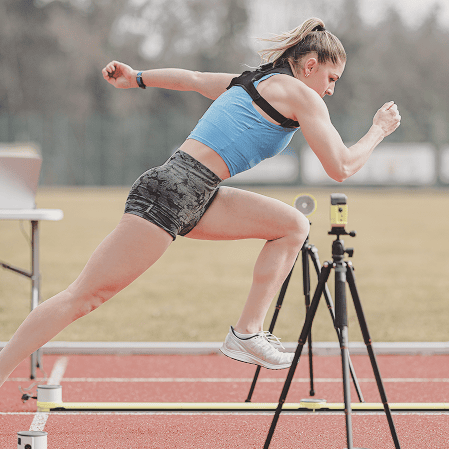
Configuration 2

Analysis of contact and flight times in running

Every runner can improve their running by optimising stride and technique and reducing injury risk. Optojump Next measures asymmetry, cadence, stride length, contact times and vertical load, helping to correct imbalances and overloads. Combined with Gyko, data on vertical accelerations and postural control is also obtained for a complete performance analysis.
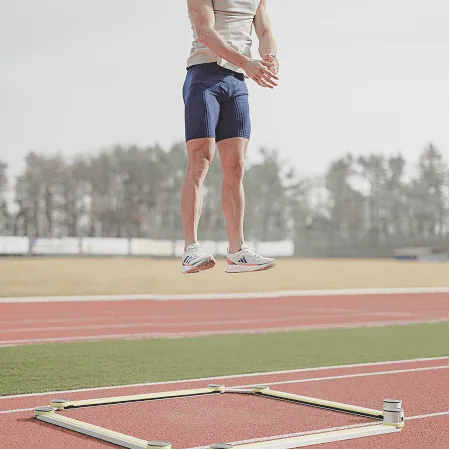
Configuration 3

Reactive jumps in biofeedback (height vs contact time)

During reactive and plyometric jumps, OptoJump Next provides real-time
feedback on jump height or contact time, depending on the exercise objective.
The athlete immediately adapts the motor strategy, improving power, reactivity
and movement quality. Biofeedback guides movement optimisation without
increasing load.

Products suited for this field of application

Witty Timing allows precise measurement of sprints, accelerations and intermediate times. OptoJump Next allows analysing running by detecting contact and flight times and spatiotemporal parameters. Together, they offer a complete and objective assessment of running and sprint performance.
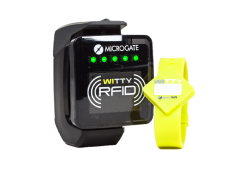
Athlete Identification

Identification Systems

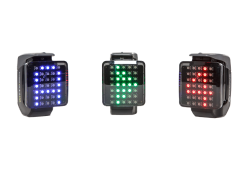
Smart lights

Cognitive trainingMotor Evaluation

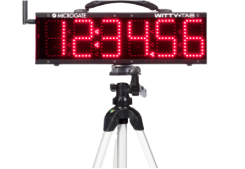
Scoreboard

Scoreboards

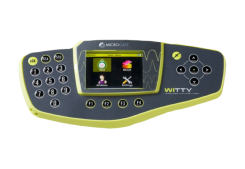
Ergonomic Stopwatch

Motor EvaluationTiming Device

OUR COMPOSITE SYSTEMS

Portable training Lab

The Microgate portable laboratory offers a comprehensive solution for evaluating and optimizing athletic performance on the field, suitable and adaptable for any type of sport. It integrates GYKO Pro for strength, balance and mobility, Optojump Next for functional movement analysis, WITTY SEM for agility and cognitive stimuli, and WITTY Timing System for sprints and changes of direction. It enables targeted training, real-time monitoring, and immediate feedback, helping coaches and trainers identify strengths and weaknesses, optimize technique, speed, and decision-making, and provides a foundation for planning personalized and effective training programs

Download PDF

Real-time performance

Train with precision and monitor every improvement.
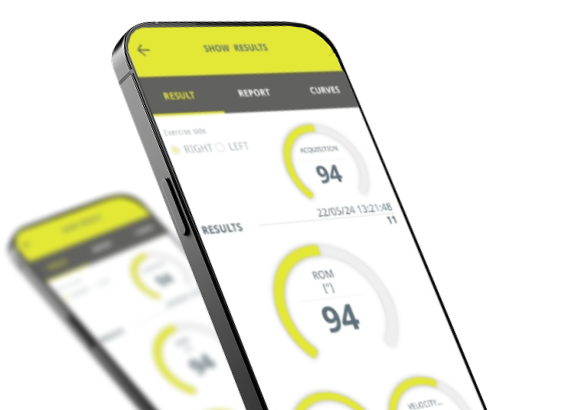
With ProMove, you can turn sprint, agility, reactivity, and cognitive training into immediate and easy-to-analyze data.

Configure devices, manage athletes, and view real-time results directly from your smartphone or tablet.

OTHER FIELDS OF USE FOR TRAINING